


The Times They Are a-Changin'
Radiolab
09/13/24
•24m
About
Comments
Featured In
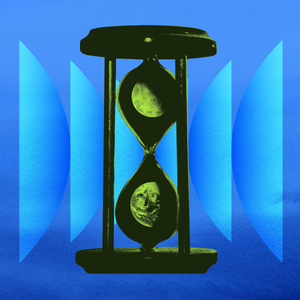
This episode first aired back in December of 2013, and at the start of that new year, the team was cracking open fossils, peering back into ancient seas, and looking up at lunar skies only to find that a year is not quite as fixed as we thought it was.
With the help of paleontologist Neil Shubin, reporter Emily Graslie and the Field Museum's Paul Mayer we discover that our world is full of ancient coral calendars. Each one of these sea skeletons reveals that once upon a very-long-time-ago, years were shorter by over forty days. And astrophysicist Chis Impey helps us comprehend how the change is all to be blamed on a celestial slow dance with the moon.
Plus, Robert indulges his curiosity about stopping time and counteracting the spinning of the spheres by taking astrophysicist Neil deGrasse Tyson on a (theoretical) trip to Venus with a rooster and sprinter Usain Bolt.
We have some exciting news! In the “Zoozve” episode, Radiolab named its first-ever quasi-moon, and now it's your turn! Radiolab has teamed up with The International Astronomical Union to launch a global naming contest for one of Earth’s quasi-moons. This is your chance to make your mark on the heavens. Submit your name ideas now through September, or vote on your favorites starting in November: https://radiolab.org/moon
Signup for our newsletter!! It includes short essays, recommendations, and details about other ways to interact with the show. Sign up (https://radiolab.org/newsletter)!
Radiolab is supported by listeners like you. Support Radiolab by becoming a member of The Lab (https://members.radiolab.org/) today.
Follow our show on Instagram,X (formerly Twitter) and Facebook
@radiolab, and share your thoughts with us by emailing radiolab@wnyc.org.
Leadership support for Radiolab’s science programming is provided by the Gordon and Betty Moore Foundation, Science Sandbox, a Simons Foundation Initiative, and the John Templeton Foundation. Foundational support for Radiolab was provided by the Alfred P. Sloan Foundation.
Hosted by Simplecast, an AdsWizz company. See pcm.adswizz.com for information about our collection and use of personal data for advertising.
Previous Episode

Shell Game
September 6, 2024
•53m
One man secretly hands off more and more of his life to an AI voice clone.
Today, we feature veteran journalist Evan Ratliff who - for his new podcast Shell Game - decided to slowly replace himself bit by bit with an AI voice clone, to see how far he could actually take it. Could it do the mundane phone calls he’d prefer to skip? Could it get legal advice for him? Could it go to therapy for him? Could it parent his kids? Evan feeds his bot the most intimate details about his life, and lets the bot loose in high-stakes situations at home and at work. Which bizarro version of him will show up? The desperately-agreeable conversationalist, the crank-yanking prank caller, the glitched out stranger who sounds like he’s in the middle of a mental breakdown, or someone else entirely? Will people believe it’s really him? And how will they act if they don’t? A gonzo journalistic experiment for the age of AI, that’s funny and eerie all at the same time.
We have some exciting news! In the “Zoozve” episode, Radiolab named its first-ever quasi-moon, and now it's your turn! Radiolab has teamed up with The International Astronomical Union to launch a global naming contest for one of Earth’s quasi-moons. This is your chance to make your mark on the heavens. Submit your name ideas now through September, or vote on your favorites starting in November: https://radiolab.org/moon
EPISODE CREDITS:
Reported by - Evan Ratliff
Produced by - Sophie Bridges and Simon Adler
With help from - Evan Ratliff
Fact-checking by - Emily Krieger
EPISODE CITATIONS:
Audio:
If you want to listen to more of Evan’s Shell Game, you can do so here, https://www.shellgame.co/
Sign up for our newsletter!! It includes short essays, recommendations, and details about other ways to interact with the show. Sign up (https://radiolab.org/newsletter)!
Radiolab is supported by listeners like you. Support Radiolab by becoming a member of The Lab (https://members.radiolab.org/) today.
Follow our show on Instagram, Twitter and Facebook @radiolab, and share your thoughts with us by emailing radiolab@wnyc.org.
Leadership support for Radiolab’s science programming is provided by the Gordon and Betty Moore Foundation, Science Sandbox, a Simons Foundation Initiative, and the John Templeton Foundation. Foundational support for Radiolab was provided by the Alfred P. Sloan Foundation.
Hosted by Simplecast, an AdsWizz company. See pcm.adswizz.com for information about our collection and use of personal data for advertising.
Next Episode

A Little Pompeiian Fish Sauce Goes a Long Way
September 20, 2024
•39m
Today we follow a sleuth who has spent over a decade working to solve an epic mystery hiding in plain historical sight: did anyone survive the eruption of Mount Vesuvius in 79AD?
Tired of hearing the conventional narrative that every Pompeiian perished without any evidence to back it up, Classicist Steven Tuck decides to look into it himself. Although he is nearly two millennia late to ground zero, he uses all the available evidence to reimagine the disaster from the perspective of the people on the ground. Could anyone have survived the volcano? If they did, could they have survived what came after that: earthquakes, tsunamis, pumice stones hurtling like missiles from the sky? If someone did survive, what happened to them after that??! To find out we have to think, feel and possibly even eat like Ancient Romans.
An against-all-odds story of a disaster without warning, a mass disappearance without a trace, and oddly, a particularly stinky fish sauce, care of special guest Chef Samin Nosrat.
We have some exciting news! In the “Zoozve” episode, Radiolab named its first-ever quasi-moon, and now it's your turn! Radiolab has teamed up with The International Astronomical Union to launch a global naming contest for one of Earth’s quasi-moons. This is your chance to make your mark on the heavens. Submit your name ideas now through September, or vote on your favorites starting in November: https://radiolab.org/moon
EPISODE CREDITS:
Reported by - Latif Nasser
with help from - Annie McEwen and Ekedi Fausther-Keys
Produced by - Annie McEwen
Recording help from - Adam Howell
Voice acting by - Brandon Dalton
Original music and sound design contributed by - Jeremy Bloom and Annie McEwen
with mixing help from - Arianne Wack
and Hosting Helo from - Sarah Qari
Fact-checking by - Emily Krieger
and Edited by - Pat Walters
EPISODE CITATIONS:
Recipes -
Ancient Roman recipe for garum (https://zpr.io/gMNmXcNZUhZg).
Read more about garum here (https://zpr.io/4gh939TxCRpZ) or in Sally Grainger’s book The Story of Garum: Fermented Fish Sauce and Salted Fish in the Ancient World
Articles -
On Pliny's letters and the eruption including a reanalysis of the date of the eruption, Pedar Foss, Pliny and the Eruption of Vesuvius (https://zpr.io/kQH49ttRawNZ)
Documentaries -
A recent PBS documentary, Pompeii: The New Dig (https://zpr.io/LV9sWKc4vbQ8) including segments on Steven Tuck’s work.
Photos and Maps -
To trace building locations or names of home owners as well as photos of every square inch of Pompeii: https://pompeiiinpictures.com/pompeiiinpictures/
From Steven Tuck: “If someone has an otherwise unbeatable case of insomnia, my preliminary publication of findings is in Reflections: Harbour City Deathscapes in Roman Italy and Beyond” (https://zpr.io/3pETS53A9CtF)
Brief description of the casts and casting process of the remains found at Pompeii: https://pompeiisites.org/en/pompeii-map/analysis/the-casts/
Maps of the Ancient Roman world that you can use to trace some of the land and sea routes discussed in the episode: https://orbis.stanford.edu
Signup for our newsletter! It includes short essays, recommendations, and details about other ways to interact with the show. Sign up (https://radiolab.org/newsletter)!
Radiolab is supported by listeners like you. Support Radiolab by becoming a member of The Lab (https://members.radiolab.org/) today.
Follow our show on Instagram, X, formerly
If you like this episode you’ll love





Promoted