


The Fellowship of the Tree Rings
Radiolab
07/14/23
•29m
About
Comments
Featured In
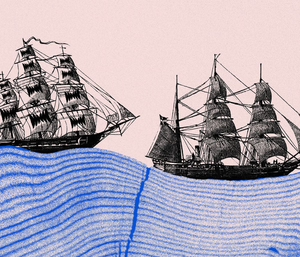
At a tree ring conference in the relatively treeless city of Tucson, Arizona, three scientists walk into a bar. The trio gets to talking, trying to explain a mysterious set of core samples from the Florida Keys. At some point, they come up with a harebrained idea: put the tree rings next to a seemingly unrelated dataset. Once they do, they notice something that no one has ever noticed before, a force of nature that helped shape modern human history and that is eerily similar to what’s happening on our planet right now. With help from pirates, astronomers and an 80-year-old bartender, this episode will change the way you look at the sun. (Warning: Do not look at the sun.)
Special thanks to Scott St George, Nathaniel Millett, Michael Charles Stambaugh, Justin Maxwell, Clay Tucker, Willem Klooster, Kevin Anchukaitis
EPISODE CREDITS
Reported by - Latif Nasserwith help from - Ekedi Fausther-Keeys and Maria Paz GutierrezProduced by - Maria Paz Gutierrez and Pat Walterswith help from - Ekedi Fausther-Keeys and Sachi MulkeyMixed by - Jeremy Bloomwith mixing help from - Arianne WackFact-checking by - Natalie Middletonand Edited by - Pat Walters
CITATIONS:
Books:
Tree Story (https://zpr.io/ULX279uzgW9q) by Valerie TrouetSweetness and Power (https://zpr.io/cUEGqGGWMSaQ) by Sidney Mintz
Our newsletter comes out every Wednesday. It includes short essays, recommendations, and details about other ways to interact with the show. Sign up (https://radiolab.org/newsletter)!
Radiolab is supported by listeners like you. Support Radiolab by becoming a member of The Lab (https://members.radiolab.org/) today.
Follow our show on Instagram, Twitter and Facebook @radiolab, and share your thoughts with us by emailing radiolab@wnyc.org.
Leadership support for Radiolab’s science programming is provided by the Gordon and Betty Moore Foundation, Science Sandbox, a Simons Foundation Initiative, and the John Templeton Foundation. Foundational support for Radiolab was provided by the Alfred P. Sloan Foundation.
Hosted by Simplecast, an AdsWizz company. See pcm.adswizz.com for information about our collection and use of personal data for advertising.
Previous Episode
Man Against Horse
July 7, 2023
•56m
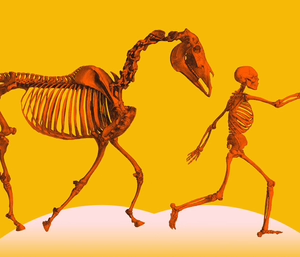
This is a story about your butt. It’s a story about how you got your butt, why you have your butt, and how your butt might be one of the most important and essential things for you being you, for being human.
In this episode from 2019, Reporter Heather Radke and Producer Matt Kielty talk to two researchers who followed the butt from our ancient beginnings through millions of years of evolution, all the way to today, out to a valley in Arizona, where our butts are put to the ultimate test.
Special thanks to Michelle Legro.
EPISODE CREDITS:
Reported by - Heather Radke and Matt KieltyProduced by - Matt Kieltywith help from - Simon Adler and Rachael CusickOriginal music and sound design contributed by - Jeremy BloomFact-checking by - Dorie Chevlen
EPISODE CITATIONS:
Books: Butts by Heather Radke
Our newsletter comes out every Wednesday. It includes short essays, recommendations, and details about other ways to interact with the show. Sign up (https://radiolab.org/newsletter)!
Radiolab is supported by listeners like you. Support Radiolab by becoming a member of The Lab (https://members.radiolab.org/) today.
Follow our show on Instagram, Twitter and Facebook @radiolab, and share your thoughts with us by emailing radiolab@wnyc.org
Leadership support for Radiolab’s science programming is provided by the Gordon and Betty Moore Foundation, Science Sandbox, a Simons Foundation Initiative, and the John Templeton Foundation. Foundational support for Radiolab was provided by the Alfred P. Sloan Foundation .
Hosted by Simplecast, an AdsWizz company. See pcm.adswizz.com for information about our collection and use of personal data for advertising.
Next Episode

The Right Stuff
July 21, 2023
•41m
Since the beginning of the space program, we’ve expected astronauts to be fully-abled athletic overachievers—one-part science geeks, two-part triathletes—a mix the writer Tom Wolfe called “the right stuff.”
But what if, this whole time, we’ve had it wrong?
In this episode from 2022, reporter Andrew Leland joins blind Linguistics Professor Sheri Wells-Jensen and a crew of 11 other disabled people. They embark on a mission to prove not just that they have what it takes to go to space, but that disability gives them an edge. On Mission AstroAccess, the crew members hop on an airplane to take a zero-gravity flight—the same NASA uses to train astronauts. With them, we learn that the challenges to making space accessible may not be the ones we thought. And Andrew, who is legally blind, confronts unexpected conclusions of his own.
By the way, Andrew’s new book is out. In The Country of the Blind: A Memoir at the End of Sight (https://zpr.io/nLZ8H), Andrew recounts his transition from sighted to blind. Suspended between anxiety and anticipation, he also begins to explore the many facets of blindness as a culture. It’s well worth a read.
Read the article by Sheri Wells-Jensen, published in The Scientific American in 2018. “The Case for Disabled Astronaut” (https://zpr.io/nLZ8H).
This episode was reported by Andrew Leland and produced by María Paz Gutiérrez, Matt Kielty and Pat Walters. Jeremy Bloom contributed music and sound design. Production sound recording by Dan McCoy. Special thanks to William Pomerantz, Sheyna Gifford, Jim Vanderploeg, Tim Bailey, and Bill Barry
Our newsletter comes out every Wednesday. It includes short essays, recommendations, and details about other ways to interact with the show. Sign up (https://radiolab.org/newsletter)!
Radiolab is supported by listeners like you. Support Radiolab by becoming a member of The Lab (https://members.radiolab.org/) today.
Follow our show on Instagram, Twitter and Facebook @radiolab, and share your thoughts with us by emailing radiolab@wnyc.orgLeadership support for Radiolab’s science programming is provided by the Gordon and Betty Moore Foundation, Science Sandbox, a Simons Foundation Initiative, and the John Templeton Foundation. Foundational support for Radiolab was provided by the Alfred P. Sloan Foundation .
Hosted by Simplecast, an AdsWizz company. See pcm.adswizz.com for information about our collection and use of personal data for advertising.
If you like this episode you’ll love


Promoted