


The Cataclysm Sentence
Radiolab
06/30/23
•73m
About
Comments
Featured In
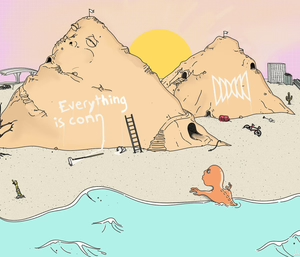
Sad news for all of us: producer Rachael Cusick— who brought us soul-stirring stories rethinking grief (https://zpr.io/GZ6xEvpzsbHU) and solitude (https://zpr.io/eT5tAX6JtYra), as well as colorful musings on airplane farts (https://zpr.io/CNpgUijZiuZ4) and belly flops (https://zpr.io/uZrEz27z63CB) and Blueberry Earths (https://zpr.io/EzxgtdTRGVzz)— is leaving the show. So we thought it perfect timing to sit down with her and revisit another brainchild of hers, The Cataclysm Sentence, a collection of advice for The End.
To explain: one day in 1961, the famous physicist Richard Feynman stepped in front of a Caltech lecture hall and posed this question to a group of undergraduate students: “If, in some cataclysm, all of scientific knowledge were to be destroyed, and only one sentence was passed on to the next generation of creatures, what statement would contain the most information in the fewest words?” Now, Feynman had an answer to his own question—a good one. But his question got the entire team at Radiolab wondering, what did his sentence leave out? So we posed Feynman’s cataclysm question to some of our favorite writers, artists, historians, futurists—all kinds of great thinkers. We asked them “What’s the one sentence you would want to pass on to the next generation that would contain the most information in the fewest words?” What came back was an explosive collage of what it means to be alive right here and now, and what we want to say before we go.
Featuring:Richard Feynman, physicist - The Pleasure of Finding Things Out (https://zpr.io/5KngTGibPVDw)
Caitlin Doughty, mortician - Will My Cat Eat My Eyeballs (https://zpr.io/Wn4bQgHzDRDB)
Esperanza Spalding, musician - 12 Little Spells (https://zpr.io/KMjYrkwrz9dy)
Cord Jefferson, writer - Watchmen (https://zpr.io/ruqKDQGy5Rv8)
Merrill Garbus, musician - I Can Feel You Creep Into My Private Life (https://zpr.io/HmrqFX8RKuFq)
Jenny Odell, writer - How to do Nothing (https://zpr.io/JrUHu8dviFqc)
Maria Popova, writer - Brainpickings (https://zpr.io/vsHXphrqbHiN)
Alison Gopnik, developmental psychologist - The Gardener and the Carpenter (https://zpr.io/ewtJpUYxpYqh)
Rebecca Sugar, animator - Steven Universe (https://zpr.io/KTtSrdsBtXB7)
Nicholson Baker, writer - Substitute (https://zpr.io/QAh2d7J9QJf2)
James Gleick, writer - Time Travel (https://zpr.io/9CWX9q3KmZj8)
Lady Pink, artist - too many amazing works to pick just one (https://zpr.io/FkJh6edDBgRL)
Jenny Hollwell, writer - Everything Lovely, Effortless, Safe (https://zpr.io/MjP5UJb3mMYP)
Jaron Lanier, futurist - Ten Arguments for Deleting Your Social Media Accounts Right Now (https://zpr.io/bxWiHLhPyuEK)
Missy Mazzoli, composer - Proving Up (https://zpr.io/hTwGcHGk93Ty)
Special Thanks to:
Ella Frances Sanders, and her book, "Eating the Sun" (https://zpr.io/KSX6DruwRaYL), for inspiring this whole episode.
Caltech for letting us use original audio o...
Previous Episode

Americanish
June 23, 2023
•73m
Given reporter Julia Longoria’s long love affair with the Supreme Court, it’s no surprise she’s become the new host of More Perfect (https://zpr.io/4R9fMg9gJ96k), a show all about how the Supreme Court got to be so... supreme. This week, we talk to Julia about her journey to the host seat, and we highlight an episode she produced for Radiolab in 2019 about a specific case: González v. Williams.
In 1903 the U.S. Supreme Court refused to say that Isabel González was a citizen of the United States. Then again, they said, she wasn’t exactly an immigrant either. And they said that the U.S. territory of Puerto Rico, Isabel’s home, was “foreign to the United States in a domestic sense.” Since then, the U.S. has cleared up at least some of the confusion about U.S. territories and the status of people born in them.
But, more than a hundred years later, there is still a U.S. territory that has been left in limbo: American Samoa. It is the only place on Earth that is U.S. soil, but people who are born there are not automatically U.S. citizens. When we visit American Samoa, we discover that there are some pretty surprising reasons why many American Samoans prefer it that way.
EPISODE CREDITS
Reported by - Julia Longoria
Our newsletter comes out every Wednesday. It includes short essays, recommendations, and details about other ways to interact with the show. Sign up (https://radiolab.org/newsletter)!
Radiolab is supported by listeners like you. Support Radiolab by becoming a member of The Lab (https://members.radiolab.org/) today.
Follow our show on Instagram, Twitter and Facebook @radiolab, and share your thoughts with us by emailing radiolab@wnyc.org
Leadership support for Radiolab’s science programming is provided by the Gordon and Betty Moore Foundation, Science Sandbox, a Simons Foundation Initiative, and the John Templeton Foundation. Foundational support for Radiolab was provided by the Alfred P. Sloan Foundation .
Hosted by Simplecast, an AdsWizz company. See pcm.adswizz.com for information about our collection and use of personal data for advertising.
Next Episode
Man Against Horse
July 7, 2023
•56m
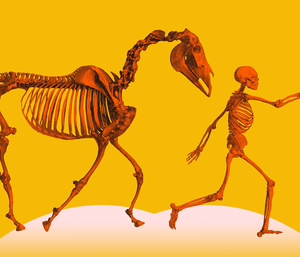
This is a story about your butt. It’s a story about how you got your butt, why you have your butt, and how your butt might be one of the most important and essential things for you being you, for being human.
In this episode from 2019, Reporter Heather Radke and Producer Matt Kielty talk to two researchers who followed the butt from our ancient beginnings through millions of years of evolution, all the way to today, out to a valley in Arizona, where our butts are put to the ultimate test.
Special thanks to Michelle Legro.
EPISODE CREDITS:
Reported by - Heather Radke and Matt KieltyProduced by - Matt Kieltywith help from - Simon Adler and Rachael CusickOriginal music and sound design contributed by - Jeremy BloomFact-checking by - Dorie Chevlen
EPISODE CITATIONS:
Books: Butts by Heather Radke
Our newsletter comes out every Wednesday. It includes short essays, recommendations, and details about other ways to interact with the show. Sign up (https://radiolab.org/newsletter)!
Radiolab is supported by listeners like you. Support Radiolab by becoming a member of The Lab (https://members.radiolab.org/) today.
Follow our show on Instagram, Twitter and Facebook @radiolab, and share your thoughts with us by emailing radiolab@wnyc.org
Leadership support for Radiolab’s science programming is provided by the Gordon and Betty Moore Foundation, Science Sandbox, a Simons Foundation Initiative, and the John Templeton Foundation. Foundational support for Radiolab was provided by the Alfred P. Sloan Foundation .
Hosted by Simplecast, an AdsWizz company. See pcm.adswizz.com for information about our collection and use of personal data for advertising.
If you like this episode you’ll love


Promoted