



Smog Cloud Silver Lining
Radiolab
09/22/23
•31m
About
Comments
Featured In
Summer 2023 was a pretty scary one for the planet. Global temperatures in June and July reached record highs. And over in the North Atlantic Sea, the water temperature spiked to off-the-chart levels. Some people figured that meant we were about to go over the edge, doomsday. In the face of this, Hank Green (a long time environmentalist and science educator behind SciShow, Crash Course, and more), took to social media to put things in context, to keep people focused on what we can do about climate change.
In the process, he came across a couple studies that suggested a reduction in sulfurous smog from cargo ships may have accidentally warmed the waters. And while Hank saw a silver lining around those smog clouds, the story he told—about smog clouds and cooling waters and the problem of geoengineering—took us on a rollercoaster ride of hope and terror. Ultimately, we had to wrestle with the question of what we should be doing about climate change, or what we should even talk about.Special thanks to Dr. Colin Carson and Avishay Artsy.
EPISODE CREDITS:
Reported by - Lulu Millerwith help from - Alyssa Jeong PerryProduction help from - Alyssa Jeong PerryOriginal music and sound design contributed by - Jeremy Bloomwith mixing help from - Jeremy BloomFact-checking by - Natalie Middletonand Edited by - N/A
CITATIONS:
Videos:
Sci Show (https://www.youtube.com/@SciShow)
Crash Course (https://www.youtube.com/crashcourse)
Articles:
The article Hank came across (https://zpr.io/zKYxWht3Nmy7)
Books:
Under a White Sky (https://zpr.io/zKYxWht3Nmy7): The Nature of the Future by Elizabeth Kolbert
Our newsletter comes out every Wednesday. It includes short essays, recommendations, and details about other ways to interact with the show. Sign up (https://radiolab.org/newsletter)!
Radiolab is supported by listeners like you. Support Radiolab by becoming a member of The Lab (https://members.radiolab.org/) today.
Follow our show on Instagram, Twitter and Facebook @radiolab, and share your thoughts with us by emailing radiolab@wnyc.org.
Leadership support for Radiolab’s science programming is provided by the Gordon and Betty Moore Foundation, Science Sandbox, a Simons Foundation Initiative, and the John Templeton Foundation. Foundational support for Radiolab was provided by the Alfred P. Sloan Foundation.
Hosted by Simplecast, an AdsWizz company. See pcm.adswizz.com for information about our collection and use of personal data for advertising.
Previous Episode
Driverless Dilemma
September 15, 2023
•41m
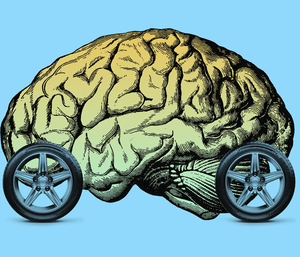
Most of us would sacrifice one person to save five. It’s a pretty straightforward bit of moral math. But if we have to actually kill that person ourselves, the math gets fuzzy.
That’s the lesson of the classic Trolley Problem, a moral puzzle that fried our brains in an episode we did almost 20 years ago, then updated again in 2017. Historically, the questions posed by The Trolley Problem are great for thought experimentation and conversations at a certain kind of cocktail party. Now, new technologies are forcing that moral quandary out of our philosophy departments and onto our streets.
So today, we revisit the Trolley Problem and wonder how a two-ton hunk of speeding metal will make moral calculations about life and death that still baffle its creators.
Special thanks to Iyad Rahwan, Edmond Awad and Sydney Levine from the Moral Machine group at MIT. Also thanks to Fiery Cushman, Matthew DeBord, Sertac Karaman, Martine Powers, Xin Xiang, and Roborace for all of their help. Thanks to the CUNY Graduate School of Journalism students who collected the vox: Chelsea Donohue, Ivan Flores, David Gentile, Maite Hernandez, Claudia Irizarry-Aponte, Comice Johnson, Richard Loria, Nivian Malik, Avery Miles, Alexandra Semenova, Kalah Siegel, Mark Suleymanov, Andee Tagle, Shaydanay Urbani, Isvett Verde and Reece Williams.
EPISODE CREDITS
Reported and produced by - Amanda Aronczyk and Bethel HabteOur newsletter comes out every Wednesday. It includes short essays, recommendations, and details about other ways to interact with the show. Sign up (https://radiolab.org/newsletter)!
Radiolab is supported by listeners like you. Support Radiolab by becoming a member of The Lab (https://members.radiolab.org/) today.
Follow our show on Instagram, Twitter and Facebook @radiolab, and share your thoughts with us by emailing radiolab@wnyc.org
Leadership support for Radiolab’s science programming is provided by the Gordon and Betty Moore Foundation, Science Sandbox, a Simons Foundation Initiative, and the John Templeton Foundation. Foundational support for Radiolab was provided by the Alfred P. Sloan Foundation .
Hosted by Simplecast, an AdsWizz company. See pcm.adswizz.com for information about our collection and use of personal data for advertising.
Next Episode

Poison Control
September 29, 2023
•35m
Originally aired in 2018, this episode features reporter Brena Farrell as a new mom. Her son gave her and her husband a scare -- prompting them to call Poison Control. For Brenna, the experience was so odd, and oddly comforting, that she decided to dive into the birth story of this invisible network of poison experts, and try to understand the evolving relationship we humans have with our poisonous planet. As we learn about how poison control has changed over the years, we end up wondering what a place devoted to data and human connection can tell us about ourselves in this cultural moment of anxiety and information-overload.
Our newsletter comes out every Wednesday. It includes short essays, recommendations, and details about other ways to interact with the show. Sign up (https://radiolab.org/newsletter)!
Radiolab is supported by listeners like you. Support Radiolab by becoming a member of The Lab (https://members.radiolab.org/) today.
Follow our show on Instagram, Twitter and Facebook @radiolab, and share your thoughts with us by emailing radiolab@wnyc.org.
Leadership support for Radiolab’s science programming is provided by the Gordon and Betty Moore Foundation, Science Sandbox, a Simons Foundation Initiative, and the John Templeton Foundation. Foundational support for Radiolab was provided by the Alfred P. Sloan Foundation.
Hosted by Simplecast, an AdsWizz company. See pcm.adswizz.com for information about our collection and use of personal data for advertising.
If you like this episode you’ll love



Promoted