


Little Black Holes Everywhere
Radiolab
07/28/23
•34m
About
Comments
Featured In
In 1908, on a sunny, clear, quiet morning in Siberia, witnesses recall seeing a blinding light streak across the sky, and then... the earth shook, a forest was flattened, fish were thrown from streams, and roofs were blown off houses. The “Tunguska event,” as it came to be known, was one of the largest extraterrestrial impact events in Earth’s history. But what kind of impact—what exactly struck the earth in the middle of Siberia?—is still up for debate. Producer Annie McEwen dives into one idea that suggests a culprit so mysterious, so powerful, so... tiny, you won’t believe your ears. And stranger still, it may be in you right now. Or, according to Senior Correspondent Molly Webster, it could be You.EPISODE CREDITS Reported by - Annie McEwen and Molly WebsterProduced by - Annie McEwen and Becca Bresslerwith help from - Matt KieltyOriginal music and sound design contributed by - Jeremy Bloom, Annie McEwen, Matt KieltyMixing by - Jeremy Bloomwith dialogue mixing by - Arianne WackFact-checking by - Diane Kellyand edited by - Alex Neason
GUESTS Matt O’Dowd (https://www.mattodowd.space/)Special Thanks:
Special thanks to, Matthew E. Caplan, Brian Greene, Priyamvada Natarajan , Almog Yalinewich
EPISODE CITATIONS
Videos: Watch “PBS Space Time,” (https://zpr.io/GNhVAWDday49) the groovy show and side-gig of physicist and episode guest Matt O’Dowd
Articles: Read more (https://zpr.io/J4cKYG5uTgNf) about the Tunguska impact event! Check out the paper (https://zpr.io/vZxkKtGQczBL), which considers the shape of the crater a primordial black hole would make, should it hit earth: “Crater Morphology of Primordial Black Hole Impacts”Curious to learn more about black holes possibly being dark matter? You can in the paper (https://zpr.io/sPpuSwhGFkDJ), “Exploring the high-redshift PBH- ΛCDM Universe: early black hole seeding, the first stars and cosmic radiation backgrounds”
Books:
Get your glow on – Senior Correspondent Molly Webster has a new kids book, a fictional tale about a lonely Little Black Hole (https://zpr.io/e8EKrM7YF32T)
Our newsletter comes out every Wednesday. It includes short essays, recommendations, and details about other ways to interact with the show. Sign up (https://radiolab.org/newsletter)!
Radiolab is supported by listeners like you. Support Radiolab by becoming a member of The Lab (https://members.radiolab.org/) today.
Follow our show on Instagram, Twitter and Facebook @radiolab, and share your thoughts with us by emailing radiolab@wnyc.org.
Leadership support for Radiolab’s science programming is provided by the Gordon and Betty Moore Foundation, Science Sandbox, a Simons Foundation Initiative, and the John Templeton Foundation. Foundational support for Radiolab was provided by the Alfred P. Sloan Foundation.
Hosted by Simplecast, an AdsWizz company. See pcm.adswizz.com for information about our collection and use of personal data for advertising.
Previous Episode

The Right Stuff
July 21, 2023
•41m
Since the beginning of the space program, we’ve expected astronauts to be fully-abled athletic overachievers—one-part science geeks, two-part triathletes—a mix the writer Tom Wolfe called “the right stuff.”
But what if, this whole time, we’ve had it wrong?
In this episode from 2022, reporter Andrew Leland joins blind Linguistics Professor Sheri Wells-Jensen and a crew of 11 other disabled people. They embark on a mission to prove not just that they have what it takes to go to space, but that disability gives them an edge. On Mission AstroAccess, the crew members hop on an airplane to take a zero-gravity flight—the same NASA uses to train astronauts. With them, we learn that the challenges to making space accessible may not be the ones we thought. And Andrew, who is legally blind, confronts unexpected conclusions of his own.
By the way, Andrew’s new book is out. In The Country of the Blind: A Memoir at the End of Sight (https://zpr.io/nLZ8H), Andrew recounts his transition from sighted to blind. Suspended between anxiety and anticipation, he also begins to explore the many facets of blindness as a culture. It’s well worth a read.
Read the article by Sheri Wells-Jensen, published in The Scientific American in 2018. “The Case for Disabled Astronaut” (https://zpr.io/nLZ8H).
This episode was reported by Andrew Leland and produced by María Paz Gutiérrez, Matt Kielty and Pat Walters. Jeremy Bloom contributed music and sound design. Production sound recording by Dan McCoy. Special thanks to William Pomerantz, Sheyna Gifford, Jim Vanderploeg, Tim Bailey, and Bill Barry
Our newsletter comes out every Wednesday. It includes short essays, recommendations, and details about other ways to interact with the show. Sign up (https://radiolab.org/newsletter)!
Radiolab is supported by listeners like you. Support Radiolab by becoming a member of The Lab (https://members.radiolab.org/) today.
Follow our show on Instagram, Twitter and Facebook @radiolab, and share your thoughts with us by emailing radiolab@wnyc.orgLeadership support for Radiolab’s science programming is provided by the Gordon and Betty Moore Foundation, Science Sandbox, a Simons Foundation Initiative, and the John Templeton Foundation. Foundational support for Radiolab was provided by the Alfred P. Sloan Foundation .
Hosted by Simplecast, an AdsWizz company. See pcm.adswizz.com for information about our collection and use of personal data for advertising.
Next Episode
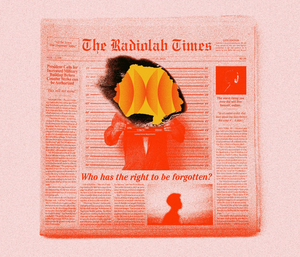
Right to be Forgotten
August 4, 2023
•54m
In online news, stories live forever. The tipsy photograph of you at the college football game? It’s there. That news article about the political rally you were marching at? It’s there. A charge for driving under the influence? That’s there, too. But what if... it wasn’t?
Several years ago a group of journalists in Cleveland, Ohio, tried an experiment that had the potential to turn things upside down: they started unpublishing content they’d already published. Photographs, names, entire articles. Every month or so, they met to decide what content stayed, and what content went. In this episode from 2019, Senior Correspondent Molly Webster takes us inside the room where the editors decided who, or what, got to be deleted. And we talk about how the “right to be forgotten” has spread and grown in the years since. It’s a story about time and memory, mistakes and second chances, and society as we know it.
Our newsletter comes out every Wednesday. It includes short essays, recommendations, and details about other ways to interact with the show. Sign up (https://radiolab.org/newsletter)!
Radiolab is supported by listeners like you. Support Radiolab by becoming a member of The Lab (https://members.radiolab.org/) today. Follow our show on Instagram, Twitter and Facebook @radiolab, and share your thoughts with us by emailing radiolab@wnyc.org
Leadership support for Radiolab’s science programming is provided by the Gordon and Betty Moore Foundation, Science Sandbox, a Simons Foundation Initiative, and the John
Hosted by Simplecast, an AdsWizz company. See pcm.adswizz.com for information about our collection and use of personal data for advertising.
If you like this episode you’ll love

Promoted