

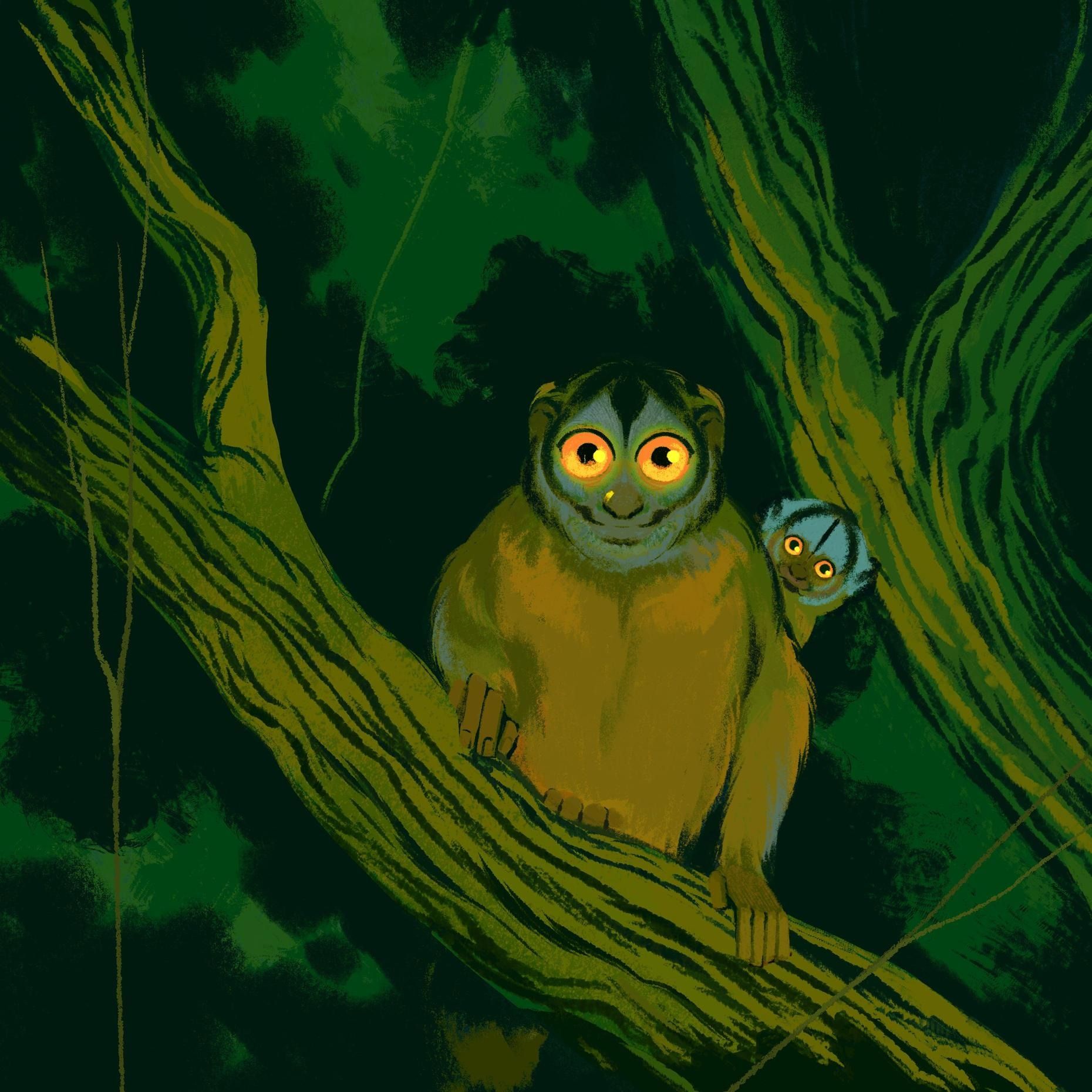

Bonus: Wild Animal Dads from Terrestrials
Radiolab
06/18/26
•35m
About
Comments
Featured In
In honor of Father's Day, here is a family friendly bonus episode from our kids' podcast Terrestrials.
What does it really mean to be a dad? In the animal world, fathers have long been painted as aggressive or absent. At best providers and protectors, but certainly not caregivers. And yet for every tale of a lion or chimp dad eating its own young (yikes!), there’s another creature who tells a sweeter story.
Two HUMAN dads bring us on this DADventure: Dr. Eduardo Fernandez-Duque, who has spent decades studying owl monkey dads in the forests of Argentina, and Michael Feigelson, who once worried he wasn't cut out for the softer side of parenting.
They introduce us to seahorse dads who get pregnant, poison dart frog dads who give piggyback rides to their tadpoles, Darwin frogs who swallow their eggs to keep them safe, burying beetles who build "corpse cribs," jacana birds who do all the egg-sitting, and stickleback fish who construct intricate underwater nests for their young. Along the way, we learn that nature doesn’t offer just one model of fatherhood. Alongside Mother Nature... there just might be a Father Nature, too.
Special thanks to the Van Leer Foundation for the support of this episode.
Resources on Animal fatherhood
- Eduardo Duque's Owl Monkey Project: https://www.owlmonkeyproject.com/
- An interview with Eduardo in Yale News
- Lauren O’Connell lab – frog behaviour
- Short explainer: frog parenting research
- Stickleback fish parenting study (Alison Bell)
- Alison Bell lab video
Human fatherhood
- Fathertime by Sarah Blaffer Hrdy
- ECM interview: evolution of “man the nurturer”
- Lee Gettler – biology of fatherhood (video)
- Lee Gettler article in Early Childhood Matters
- Darby Saxbe book: Dad Brain
- Darby Saxbe Article in Early Childhood Matters
Talks, films & convenings
- Yale Conference on Fatherhood
- Live Recording of Yale Conference:
- Fathers and Fatherhood: From Molecules to Modern Families
- Fathertime documentary
Campaigns & global perspectives
- Equimundo's State of World's fathers report
Previous Episode

On the Media: American Emergency
June 12
•55m
A little while back, our friends over at On the Media released a gripping and immersive reporting series about FEMA, the agency that is supposed to be there for all of us in the wake of disaster. In American Emergency (https://zpr.io/MtrUmJU3yEMW), OTM investigates how the agency tasked with saving America became distrusted, despised... and defunded.
Today we talk to On the Media co-host Micah Loewinger about how this project came out, what reporting went into making it happen, and play a couple of fun and truly surprising bits of the story that the OTM team uncovered. And it’s a story that highlights the ideal and promise of good government, right alongside the frustration with bureaucracy and mismanagement, and of course the undercurrent of profound mistrust in governmental power.As natural disasters are getting more extreme and less predictable, this series makes sense of that tangle, and provides a prescient peek into FEMA’s future.
Special thanks to On the Media (https://zpr.io/MtrUmJU3yEMW). To hear Micah in person, talking more about the complex history of FEMA, join him on June 24th at WNYC's The Greene Space (https://wnyc.org/events/otm-fema).
Signup for our newsletter!! It includes short essays, recommendations, and details about other ways to interact with the show. Sign up (https://radiolab.org/newsletter)!
Radiolab is supported by listeners like you. Support Radiolab by becoming a member of The Lab (https://members.radiolab.org/) today.
Follow our show on Instagram, Twitter and Facebook @radiolab, and share your thoughts with us by emailing radiolab@wnyc.org.
Leadership support for Radiolab’s science programming is provided by the Simons Foundation and the John Templeton Foundation. Foundational support for Radiolab was provided by the Alfred P. Sloan Foundation.
Hosted by Simplecast, an AdsWizz company. See pcm.adswizz.com for information about our collection and use of personal data for advertising.
Next Episode

This is Your Brain on Hormones
June 19
•39m
After reading something that said her menstrual cycle changes her brain each month, Senior Correspondent Molly Webster goes on a reporting mission to see if that’s true, and, if so, how.
This journey into sex hormones and the brain involves females and males, and exacting self-experimentation. It gets into PTSD, and ends with a new twist on self-care (hint: it’s biological). And, it starts to reveal a sneaky truth: that each one of us is at the mercy of a crashing sea of chemicals inside of us – those things we call hormones.
Special thanks to Emily Jacobs, Laura Pritschet, Pavel Shapturenka, and Dr. Catherine Woolley.
EPISODE CREDITS:
Hosted by - Molly Webster
Reported by - Molly Webster
Produced by - Mona Madgavkar
with help from - Molly Webster
Fact-checking by - Diane A. KellyEPISODE CITATIONS:
Articles -
**The experiments we feature in this episode are called: 28andMe, 28andOC, and 28andHe, all of which took place at Emily Jacobs lab at the University of California, Santa Barbara.**- The 28 Project (https://zpr.io/CSx6MnwZjRvp), background from the Jacobs lab
For more on how much variability there is between female and male animals, check out this “groundbreaking” study, referenced by Emily Jacobs in our episode
- Sex Bias in Neuroscience and Biomedical Research(https://zpr.io/ZRgKZzdNejUA), by Beery AK, Zucker I., Neurosci Biobehav Rev. 2011
Dr. Catherine Woolley has revolutionized the field of neuroscience and sex hormones, here’s more about her work ...
- Sex Differences in the Brain Get Down to the Molecular Level Sex (https://zpr.io/UNCLE9J782N5), by Stephanie DeMarco, PhD, The Scientist.com
- Hormonal Effects on the Brain (https://zpr.io/DvNM9EkXdtGG), by Woolley, C.S. and Schwartzkroin, P.A. Epilepsia
Data sets -
Audio -
In the episode, we mention Dr. Russ Poldrack and the Midnight Scan Club, as inspo for self-experimentation- The Midnight Scan Club (https://zpr.io/CLBhNQSxK844), by Science Friday.
Signup for our newsletter!! It includes short essays, recommendations, and details about other ways to interact with the show. Sign up (https://radiolab.org/newsletter)!
Radiolab is supported by listeners like you. Support Radiolab by becoming a member of The Lab (https://members.radiolab.org/) today.
Follow our show on Instagram, Twitter and Facebook @radiolab, and share your thoughts with us by emailing radiolab@wnyc.org.
Leadership support for Radiolab’s science programming is provided by the Simons Foundation and the John Templeton Foundation. Foundational support for Radiolab was provided by the Alfred P. Sloan Foundation.
Hosted by Simplecast, an AdsWizz company. S...
If you like this episode you’ll love


Promoted