



Abortion Pills, Take Two
Radiolab
04/14/23
•27m
About
Comments
Featured In
Abortion pills — a combo of two drugs, mifepristone and misoprostol — are on notice: on April 7, 2023, a federal judge said the FDA’s approval of mifepristone was invalid. And then, not more than an hour later, another federal judge in a separate case said that mifepristone had to stay on the market in certain states. With these two contradictory rulings, mifepristone — and medical abortion, in general — is in the crosshairs. So, today, we want to rewind to an episode we made last year. It looks at these two drugs over the last 40 years, from their origin stories and development, to how their administration from doctors to patients keeps evolving. This story, for us, started...
Special thanks to Mariana Prandini Assis and Pam Belluck.
EPISODE CREDITS
Reported by - Molly Webster, Avir Mitra Produced by Sarah Qariwith mixing help from - Arianne WackFact-checking by - Diane Kellyand Edited by - Becca BresslerCITATIONS:
Articles:
From one of our sources, Abigail Aiken: “Safety and effectiveness of self-managed medication abortion provided using online telemedicine in the United States: A population based study” (https://zpr.io/kG3hNFXM4kb9)
Our newsletter comes out every Wednesday. It includes short essays, recommendations, and details about other ways to interact with the show. Sign up (https://radiolab.org/newsletter)!
Radiolab is supported by listeners like you. Support Radiolab by becoming a member of The Lab (https://members.radiolab.org/) today.
Follow our show on Instagram, Twitter and Facebook @radiolab, and share your thoughts with us by emailing radiolab@wnyc.org
Leadership support for Radiolab’s science programming is provided by the Gordon and Betty Moore Foundation, Science Sandbox, a Simons Foundation Initiative, and the John Templeton Foundation. Foundational support for Radiolab was provided by the Alfred P. Sloan Foundation .
Hosted by Simplecast, an AdsWizz company. See pcm.adswizz.com for information about our collection and use of personal data for advertising.
Previous Episode

The Library of Alexandra
April 7, 2023
•43m
How much does knowledge cost? While that sounds like an abstract question, the answer is surprisingly specific: $3,096,988,440.00. That’s how much the business of publishing scientific and academic research is worth.
This is the story of one woman’s battle against a global network of academic journals that underlie published scientific research. In 2011, Alexandra Elbakyan had just moved home to Kazakhstan after a disappointing few years trying to study neuroscience in the United States when she landed on an internet forum where a bunch of scientists were all looking for the same thing: access to academic journal articles that were behind paywalls. That’s the moment the very simple, but enormously powerful, website called Sci Hub was born.
The site holds over 88 million articles and serves up about a million downloads to people in practically every country on the globe. We travel to Kazakhstan to meet the mysterious woman behind it all and to find out what it takes to make everything we know about anything available to anyone anywhere, for free.Special thanks to Vrindra Bhandari, Balázs Bodó, Stephen Buranyi, Ian Graber-Stiehl, Joel Joseph, Noorain Khalifa, Aparajita Lath, Steve McLaughlin, Marcia McNutt, Randy Scheckman Tanmay Singh, Deborah Harkness, Joe Karaganis, Lawrence Lessig, Glyn Moody, and Steven Press.
Episode Credits:Reported by - Eli CohenReporting help from - Karishma Mehrotra, Emily Krumberger and Norihelys RamosProduced by Simon Adlerwith help from - Eli CohenOriginal music and sound designed by - Simon AdlerMixing by - Jeremy BloomEdited by - Alex Neason
Our newsletter comes out every Wednesday. It includes short essays, recommendations, and details about other ways to interact with the show. Sign up (https://radiolab.org/newsletter)!
Radiolab is supported by listeners like you. Support Radiolab by becoming a member of The Lab (https://members.radiolab.org/) today.
Radiolab is on YouTube! Catch up with new episodes and hear classics from our archive. Plus, find other cool things we did in the past — like miniseries, music videos, short films and animations, behind-the-scenes features, Radiolab live shows, and more. Take a look, explore and subscribe!
Follow our show on Instagram, Twitter and Facebook @radiolab, and share your thoughts with us by emailing radiolab@wnyc.org.
Leadership support for Radiolab’s science programming is provided by the Gordon and Betty Moore Foundation, Science Sandbox, a Simons Foundation Initiative, and the John Templeton Foundation. Foundational support for Radiolab was provided by the Alfred P. Sloan Foundation.
Hosted by Simplecast, an AdsWizz company. See pcm.adswizz.com for information about our collection and use of personal data for advertising.
Next Episode
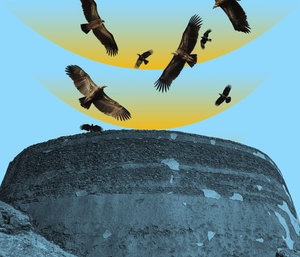
Corpse Demon
April 21, 2023
•31m
Heaven and hell, Judgement Day, monotheism — these ideas all came from one ancient Persian religion: Zoroastrianism. Also: Sky Burials. Zoroastrians put their dead on top of a structure called The Tower of Silence where vultures devour the body in a matter of hours. It’s clean, efficient, eco-friendly. It’s how it’s been for thousands of years.
Until 2006. That’s when a Zoroastrian woman living in Mumbai snuck up into the tower and found bloated, rotting bodies everywhere. The vultures were gone. And not just at the tower — all across the country.
In this episode, we follow the Kenyan bird biologist, Munir Virani, as he gets to the bottom of this. A mystery whose stakes are not just the end of an ancient burial practice, but the health of all the world’s ecosystems.
The answer, in unexpected ways, points back to us.
Special thanks to Daniel Solomon, Peter Wilson, Samik Bindu, Vibhu Prakash, Heather Natola and the Rapture Trust in New Jersey, and Avir’s uncle Hoshang Mulla, who told him about this story over Thanksgiving dinner.
EPISODE CREDITSReported by - Avir Mitrawith help from - Sindhu GnanasambandanProduced by - Sindhu Gnanasambandanwith help from - Pat WaltersOriginal music and sound design contributed by - Jeremy Bloomwith mixing help from - Arianne WackFact-checking by - Diane Kellyand Edited by - Pat Walters
Our newsletter comes out every Wednesday. It includes short essays, recommendations, and details about other ways to interact with the show. Sign up (https://radiolab.org/newsletter)!
Radiolab is supported by listeners like you. Support Radiolab by becoming a member of The Lab (https://members.radiolab.org/) today.
Follow our show on Instagram, Twitter and Facebook @radiolab, and share your thoughts with us by emailing radiolab@wnyc.org.
Leadership support for Radiolab’s science programming is provided by the Gordon and Betty Moore Foundation, Science Sandbox, a Simons Foundation Initiative, and the John Templeton Foundation. Foundational support for Radiolab was provided by the Alfred P. Sloan Foundation.
Hosted by Simplecast, an AdsWizz company. See pcm.adswizz.com for information about our collection and use of personal data for advertising.
If you like this episode you’ll love



Promoted