

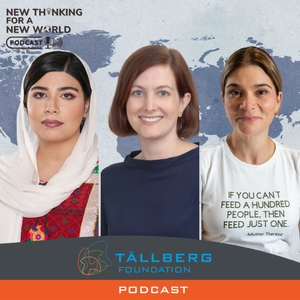

Re-thinking Education for Migrant Children
New Thinking for a New World - a Tallberg Foundation Podcast
05/02/24
•42m
About
Comments
Featured In
We live in an era of mass migration. Millions of people and families are on the move, driven by conflict, natural disasters, insecurity, and lack of opportunity. The human cost of migration is high, especially for children who often lose access to regular schooling, health care, nutrition, and other factors that will shape their futures for better or for worse.
On this episode of New Thinking for a New World, we push beyond the problems to explore solutions. Three experts share their experiences in designing and executing educational and other programs for children in distress. Listen as Pashtana Durrani (LEARN Afghanistan), Lala Lovera (Fundacion Comparte Por Una Vida Colombia), and Caroline Kronley (Tinker Foundation) discuss how it’s possible to deliver quality education even under the most complicated circumstances.
What do you think?
Previous Episode

SPOTLIGHT: “tis the mind that makes the body rich”
April 23, 2024
•13m
What do Shakespeare, neuroscientist Rafa Yuste, and human rights lawyer Jared Genser have in common? They all believe that our brains make us human. Yuste and Genser add their own coda to that belief: therefore, it is essential to define and protect mankind’s neuro rights. And through the NeuroRights Foundation which they co-founded they are working to do exactly that around the world.
The good news is that they are starting to have successes: in Colorado, California and Minnesota in the United States, as well as in Chile and Brazil.
Yuste and Genser are both past winners of the Tällberg-SNF-Eliasson Global Leadership Prize. Indeed, that’s how they met and began their collaboration.
Listen to this special Spotlight episode, as Yuste and Genser discuss the urgency of the issue and their advocacy campaign. Then tell us what you think —and nominate impactful leaders like them for this year’s Prize.
Next Episode
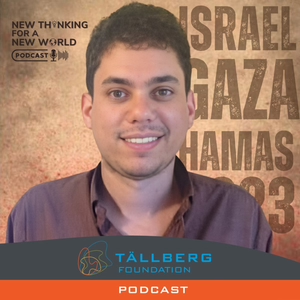
War Lessons
May 9, 2024
•40m
Almost seven months ago, Hamas terrorists stormed into Israel murdering, raping, and kidnapping. In response, Israel launched its attack on Gaza that has reportedly killed at least 34,000 people (mostly civilians), leveled much of the Gaza Strip, significantly degraded Hamas's military capacity, and killed many senior Hamas political and military commanders.
Yet the war continues and, no surprise, has spread to include Houthis, Hezbollah, Iran and a coalition of US, European and Arab forces. And the conflict has roiled politics in America and in Europe, with consequences yet to be seen.
Even though the fighting has not ended, it’s possible to think about how the conflict may be changing political dynamics in the Middle East. Are the Israelis more secure? Do the Palestinians have more possibility of achieving a state for themselves? Are Iran and Israel more or less likely to engage in a wider, deadlier war? And, what are the limits to U.S. support for Israel; indeed, is a break possible?
Armin Rosen, a US-based journalist for Tablet Magazine, has already published some of his answers to those questions and joins host Alan Stoga to **share his insights about Israel, Hamas, Iran, Hezbollah, America, the region and, of course, the war. **
What do you think? Is peace possible?
If you like this episode you’ll love




Promoted