

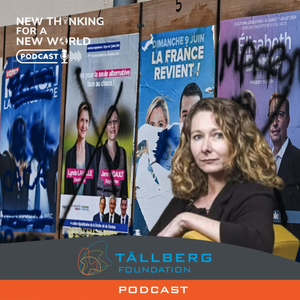

France Lurches Right
New Thinking for a New World - a Tallberg Foundation Podcast
07/04/24
•32m
About
Comments
Featured In
Much to everyone’s surprise, France’s President Macron recently decided that—like much of the rest of the world—his country ought to have national elections this year. The outcome of the first of two rounds was devastating for his political project to govern from the center: Marine Le Pen’s right-wing National Rally party won a bit more than 33% of the vote. A coalition of leftist parties, the New Popular Front, won 28%. And Macron's Centers party again came in third, 22%.
Headlines around described a “landslide” for Le Pen and speculated that the RN might win an absolute majority of legislative seats in the July 7th second round of voting. While that is one of the possibilities, it's not clear, whether it's the most likely one. What does seem clear is that French politics has entered an incredibly volatile, unpredictable, perhaps dangerous period.
Fear of the populist far right is one of the themes coursing through, perhaps defining French politics. Alice Barbe is a French political and social activist who is firmly planted on the left of the political spectrum in her country. Listen as she shares her fears and discusses her expectations for the second round of voting—and the morning after.
What do you think: can right-wing populism be democratic?
Previous Episode

Arctic Heat
June 27, 2024
•35m
That the Arctic is warming is not exactly breaking news on a planet where almost everywhere is warming. But it is critical news that the Arctic is warming almost four times faster than the rest of the globe since the polar regions are essentially the planet’s air conditioners. Last year's Arctic Report Card documented that 2023 was the Arctic's hottest summer in centuries, with all the attendant consequences: massive wildfires, late June Greenland ice sheet melt, sea surface temperatures 7oC above normal, etc.
The list of firsts, or maybe better put, worst was a long one—and the early evidence is that those were trends, not anomalies, that continue in 2024.
Are we as a planet now locked into ever more warming? Are there potential tipping points that might produce even faster change? Are there actions that can be taken on a timescale that's relevant to people living today?
Even if the answers are "Yes, Yes, No" are there initiatives at scale that are worth pursuing if only to adapt to the massive changes clearly underway? If that question elicits even a tentative "Yes", then the places to start are at the epicenters: the Arctic and Antarctica.
Tero Mustonen— Finnish environmental leader, scientist, fisherman and past recipient of the Tällberg-SNF-Eliasson Global Leadership Prize—is spending his life working to make that last “Yes” more muscular. More immediately, he recently returned from traveling across the Arctic, which gives us a rare opportunity for a firsthand debrief.
Please tell us what you think.
In the podcast, Tero mentioned arcticseas.org where you can hear the authentic voices of hunters, women, and fishers from Arctic villages as they share their knowledge, often for the first time. These communities, living sustainably in one of the planet's toughest environments, offer vital messages about coexisting with nature.
Next Episode
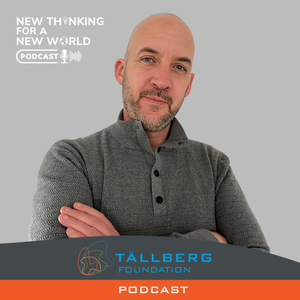
Politicians, Cartels, Murders, Oh My!
July 11, 2024
•33m
Politics in Mexico has long been a blood sport: not only “winner takes all,” but also incredibly violent. Last month’s national elections—when the country's first female president won with a record number of votes and by a record margin of victory—demonstrated both trends. President-elect Claudia Sheinbaum’s Morena party (founded and still controlled by outgoing President Andrés Manuel López Obrador) won huge national and state legislative victories. But the electoral campaign was punctuated by more than 100 political assassinations, as well as widespread kidnappings, forced disappearances, attempted murders, and attacks on family members and campaign staff—all by drug cartels competing for turf, control of markets, and quiescent politicians.
Even worse, this kind of political violence seems to be on the upswing in other parts of Latin America from Central America through the Andean countries and even into Chile. Why? The simple answer seems to be that controlling local, state, and national politicians is good for business—even if that sometimes requires killing those who have other ideas.
Can the cartels be stopped? Is Mexico becoming a narco-state? Is the infection spreading too fast in too many places to be contained?
Answers require a deep understanding of the cartels. That’s where Chris Dalby, an expert on cartel violence, comes in. He is a journalist and founder of World of Crime, which investigates and documents how the cartels operate. Listen as he explains what the Mexican cartels want and how they are getting it.
What do you think: Can Mexico beat the cartels or will the cartels beat Mexico?
If you like this episode you’ll love



Promoted