

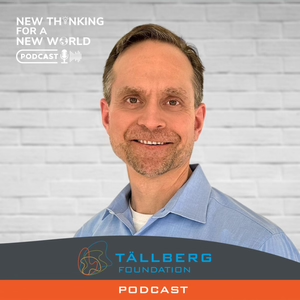

Doctor, Doctor Give Me the News
New Thinking for a New World - a Tallberg Foundation Podcast
11/27/24
•34m
About
Comments
Featured In
Healthcare is intensely personal. Even when national statistics show improvement—which has been the case for most countries over recent decades—what matters is whether my baby in rural Uganda is having trouble breathing or whether my aging father in New York who went into the hospital with a broken hip will now die from the MERS he contracted there or whether why my wife in Buenos Aries can access the drugs she needs to survive cancer.
In our hi-tech age, it seems like much of what ails us and our loved ones should be erasable using innovative technology.
Dr. Kristian Olson agrees. He's an American internist and pediatrician, based at Harvard, who practices globally, as well as a designer who helped create the Center for Affordable Medical Technology. CAMTech designs solutions—high-tech and not-so-high-tech—that produce better, affordable health outcomes.
Dr. Olson is also a winner of the 2024 Tällberg-SNF-Eliasson Global Leadership Prize recognized by the jury for his unwavering commitment to transforming healthcare especially in low and middle-income countries through human-centered design, pioneering solutions that improve lives across diverse communities.
Tell us what you think: Can smart use of technology make us—all of us—healthier?
Previous Episode
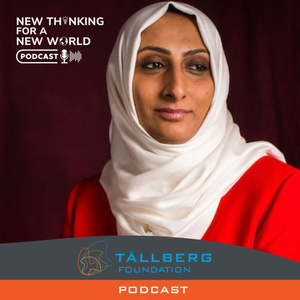
It’s Up to the Women
November 21, 2024
•28m
In 2015 the nations of the world—with much fanfare—agreed to achieve gender equality by 2030 as one of the U.N.’s “Sustainable Development Goals.” With the approach of the 10-year anniversary of that declaration, it’s obvious to even the UN statisticians that there is no possibility the goal will be realized. Indeed, if you want to be depressed (or, perhaps, angered) Google “gender inequality” and you will learn that the World Economic Forum has run the numbers and decided that “gender parity is 131 years away.”
Nonetheless, there is good news: gender gaps in some countries are being closed faster than ever, especially in Europe and North America. The bad news: there has been much less—if any—progress in most of the Global South, although there are important exceptions in countries like Saudi Arabia, UAE, Singapore, and Chile.
That should be unsurprising to anyone who wanders the world with eyes open, not shut. If so, then it’s probably also not surprising that new approaches are necessary to realize the full human potential of billions of women around the world. That almost certainly means a complete reframing of how to think about the issue as well as about possible solutions.
That is why we invited Zubaida Bai, CEO of the Grameen Foundation to join us on New Thinking for a New World. She believes that gender equality is not only essential but possible—and that it requires significant systems change to happen.
Please tell us what you think here.
Next Episode

Tyranny’s Most Dangerous Foe
December 5, 2024
•40m
Winston Churchill is alleged to have written that "A free press is the unsleeping guardian of every other right that free men prize; it is the most dangerous foe of tyranny.” Thus, it should be no surprise that at a time when clear majorities of people in most democracies don’t trust their governments or their politicians, they also don’t trust their media or the journalists that produce it. Literally, you can’t have one without the other—and today most of us have too little of both.
María Teresa Ronderos is trying to change that.
She is an accomplished Colombian investigative journalist, co-founder of the Latin American Center for Investigative Journalism (CLIP), and a recently announced winner of the 2024 Tällberg-SNF-Eliasson Global Leadership Prize.
Ronderos believes that the only way to defeat the misinformation and disinformation that corrode our democracies is with honest, deeply sourced, smart journalism. She also believes that if social media is too often the bête noire of both democracy and journalism, information technology properly used is the best antidote. Overall, she believes that good journalism is not only still possible, but is more essential than ever.
Do you agree?
If you like this episode you’ll love




Promoted