


Congo’s Unending Tragedy
New Thinking for a New World - a Tallberg Foundation Podcast
03/27/25
•37m
About
Comments
Featured In
With its unlimited natural resources and huge agricultural potential capacity, the Democratic Republic of Congo should be a paradise—but unfortunately, it’s not. Instead, it’s been wracked by war, bad government, corruption, tribal and ethnic enmities, neighbors who are serially tempted to intervene, and Great Powers who seem to think that it's time for a second age of colonialism.
Recently, well-armed militias, accompanied by the Rwandan military, have seized key provinces in the country's mineral-rich east. They're threatening to continue their offensive with an ever-changing mix of tribal, political, and economic justifications thatmay be pointing towards violent regime change in Kinshasa.
Why should we care? Obviously, because the human tragedies that define such wars should not be happening in the 21st century. But, beyond that, the Congo conflict is a dangerous microcosm of our time: international borders no longer sacrosanct; 19th-century-style natural resource grabs for 21st-century rare earth minerals; Great Power rivalries; the potential for a larger regional conflict if full-blown civil war breaks out across Africa’s second largest country.
Michela Wrong is a journalist and an author who knows Rwanda, Congo, and the Great Lakes region as well as anyone. Her recent article in Foreign Affairs, “How Far Will Rwanda Go in Congo?” provides some of the backstory to this New Thinking for a New World conversation about the huge dangers of yet another conflict in Congo.
Will Congo ever find peace? Tell us what you think and comment here.
Previous Episode

Will Palestinians and Israelis Ever Find Peace?
March 20, 2025
•31m
The brutal Hamas attacks on October 7th, 2023 kickstarted a new cycle of widespread death and destruction that continues today. Countless lives lost, shattered, or irrevocably altered. Of course, mostly Palestinian, but also Israeli. Even Donald Trump is right about some things, as when he says, "It's impossible to imagine how life can go on under such circumstances."
Indeed, it's easier to imagine how roads or houses or markets can be rebuilt than how people, Palestinians as well as Israelis, will deal with the scar tissue. Can the hate, despair, fear, and insecurity that caused the past 18 months, and has been exponentially compounded during that time, ever dissipate? Are kids who survived this war condemned to new cycles of rinse-and-repeat violence?
Even though those questions may be unanswerable, they are far more vital than all the talk about governance or reconstruction or peacekeeping that preoccupies diplomats. So this episode of New Thinking for a New World attempts to focus on people, Palestinians as well as Israelis, who are condemned to co-exist rather than on the Arab Plan or the Egyptian Plan or the Trump Plan. Francesca Borri is an Italian journalist who lives in Jenin, which helps give her reporting a totally different insight into what people are actually thinking. Gershon Baskin is an Israeli political activist and commentator with deep empathy for Palestinians and an even deeper commitment to looking for ways for people to live together.
What do you think: is Palestinian-Israeli peace possible?
Next Episode
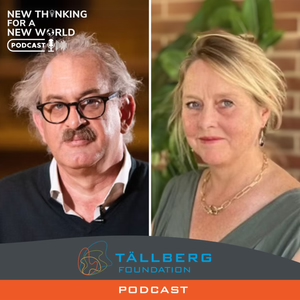
Helping Refugees Help Themselves: The Play Really is the Thing!
April 3, 2025
•40m
Shakespeare wrote in Hamlet, “The play’s the thing, wherein I’ll catch the conscience of the king,” when the troubled Prince stages a play to catch a murderer. The underlying point of the play-in-the-play is that drama is an incredibly powerful force for storytelling and much else.
Fast forward to the 21st century for an amazing example of that Shakespearean wisdom. Two incredibly creative British filmmakers created something called The Trojan Women Project to use drama to help refugees from wars in the Middle East and Ukraine cope with their trauma. The idea is elegant in its simplicity: combine the wisdom and words of Euripides’ play with the tragic lived experiences of people fleeing war and destruction, as therapy for them and as a learning tool for audiences who are offered unique insight into what war is really like.
Charlotte Eagar and William Stirling have worked on this project for more than a decade. The Tällberg Foundation first met them in 2014 when they brought a dozen Syrian refugee cast members to one of our workshops. We witnessed an absolutely amazing performance of The Trojan Women laden with a depth of tragedy that even the greatest actors would be challenged to produce—because for the Syrians, it was their lives, not their lines they were sharing.
Listen as Charlotte and William describe how they tap into the real power of the play, and how it can transform refugees as well as audiences.
If you like this episode you’ll love



Promoted