


Africa’s Mental Health Emergency
New Thinking for a New World - a Tallberg Foundation Podcast
11/07/24
•36m
About
Comments
Featured In
It is trite, but true that youth are our future. Unfortunately, what is also true is that in most countries the mental health of young people has been declining over the past two decades, a decline that seems to have accelerated during and after COVID. Globally, one in seven 10 to 19-year-olds reportedly experience mental disorders. In turn, depression, anxiety, and behavioral issues are among the leading causes of illness, disability, and even suicide among adolescents.
What’s true globally is even more the case in Africa where 60% of people are under 24, and too many are victims of a witch's brew of climate shock, inflation, economic mismanagement, war, gang violence, epidemics, and other disasters. The resulting high incidence of youth with serious and enduring mental health disorders not only mortgages their own futures, but their countries' futures as well.
What can be done? Are there adequate resources, medical professionals, hospitals, and targeted programs focused on the challenges of youth mental health? Is there a real urgency among policymakers to address the problems?
Dr. Olayinka Omigbodun founded the Centre for Child and Adolescent Mental Health at the University of Ibadan in Nigeria where today she is Provost of the College of Medicine, the first woman to hold that position. She has devoted her life to trying to answer those and other questions about adolescent mental health.
Previous Episode

Welcome to Dante’s Inferno
October 31, 2024
•33m
Over the last several years Palestinians felt abandoned and ignored by Arabs, Americans, and Europeans. The people in Gaza and the West Bank seemed to have become almost invisible to everyone except themselves and the Israelis with whom they engaged in a low-intensity, but deadly conflict.
The attacks on October 7th and the continuing brutal Israeli response changed that, perhaps forever. Now it's hard to imagine ever returning to the status quo ante as unpleasant and unstable as that was. But all wars end, and this one will as well. The people who survive, especially the almost 50% of Gazans under the age of 18, will surely be marked for life.
So what?
That’s a harsh question, and it demands honest answers. Could the tragedy of war somehow lead to better lives and even a sovereign state for millions of Palestinians? Are Palestinians condemned to remain stuck in whatever circle of Dante's hell they now inhabit? Or might they give up and leave, even if the rest of the world doesn’t seem to want them?
Our guest on New Thinking for a New World brings the sort of experience and insight that can at least give us a window into possibilities. Francesca Borri is an Italian journalist and war reporter who has lived in the West Bank since 2007. Her work and integrity are respected by Arabs as well as Israelis. Proof point: she was the first Western journalist to interview Yahya Sinwar in 2018 and that interview led to direct negotiations between Hamas and Israel.
Can you imagine a positive ending to the tragedy in Gaza? Please tell us what you think here.
Next Episode
It’s Up to the Women
November 21, 2024
•28m
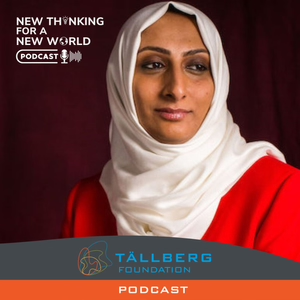
In 2015 the nations of the world—with much fanfare—agreed to achieve gender equality by 2030 as one of the U.N.’s “Sustainable Development Goals.” With the approach of the 10-year anniversary of that declaration, it’s obvious to even the UN statisticians that there is no possibility the goal will be realized. Indeed, if you want to be depressed (or, perhaps, angered) Google “gender inequality” and you will learn that the World Economic Forum has run the numbers and decided that “gender parity is 131 years away.”
Nonetheless, there is good news: gender gaps in some countries are being closed faster than ever, especially in Europe and North America. The bad news: there has been much less—if any—progress in most of the Global South, although there are important exceptions in countries like Saudi Arabia, UAE, Singapore, and Chile.
That should be unsurprising to anyone who wanders the world with eyes open, not shut. If so, then it’s probably also not surprising that new approaches are necessary to realize the full human potential of billions of women around the world. That almost certainly means a complete reframing of how to think about the issue as well as about possible solutions.
That is why we invited Zubaida Bai, CEO of the Grameen Foundation to join us on New Thinking for a New World. She believes that gender equality is not only essential but possible—and that it requires significant systems change to happen.
Please tell us what you think here.
If you like this episode you’ll love




Promoted