

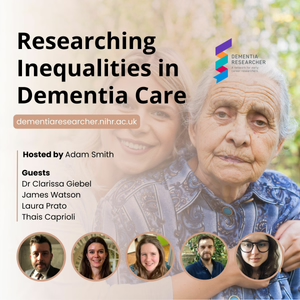

Researching Inequalities in Dementia Care
Dementia Researcher
02/06/23
•59m
About
Comments
Featured In
Adam Smith speaks with four researchers from The University of Liverpool, dedicated to better understanding (and then addressing) Inequalities in Dementia Care. This weeks guests are Dr Clarissa Giebel, Senior Research Fellow, PhD students James Watson and Thais Caprioli and Research Associate Laura Prato. Full biographies on all our guests and a transcript can be found on our website https://www.dementiaresearcher.nihr.ac.uk -- When we think of inequalities, we most focus on disparities in access, quality, and treatment. However, this is a complex topic inequality in this podcast we discuss the work of our four guests and what they have discovered working in the UK, covering: Diagnosis: People from ethnic minorities, lower socioeconomic backgrounds and those living in rural areas may be less likely to receive a timely and accurate diagnosis of dementia. Access to care: People with dementia and their caregivers may face challenges in accessing appropriate support and services, including specialist services, community support and respite care. Quality of care: The quality of care received by people with dementia may vary depending on where they live and their personal circumstances, such as their financial resources and social support. It may also be affected by the care pathway of the individual organisation treating them. Caregiver burden: Caregivers of people with dementia often experience high levels of stress, financial strain, and social isolation, particularly if they have limited support – and issue that worsened during the pandemic. Addressing these inequalities in dementia care requires a multi-faceted approach that considers social, economic, cultural, and systemic factors – which is the next step and challenge in turning research into action. -- Like what you hear? Please review, like, and share our podcast - and don't forget to subscribe to ensure you never miss an episode – and if you prefer to watch rather than listen, you’ll find a video version of this podcast with full captions on our YouTube Channel – http://www.youtube.com/dementiaresearcher -- This podcast is brought to you by University College London / UCLH NIHR Biomedical Research Centre in association with Alzheimer’s Association, Alzheimer's Research UK, Alzheimer's Society and Race Against Dementia who we thank for their ongoing support.
Previous Episode

Blood Based Biomarkers for Dementias
January 23, 2023
•56m
Over the past decade, blood-based biomarkers for dementia have been increasingly studied as way to diagnose and track the progress of Alzheimer’s and other neurodegenerative diseases. In this podcast three leading blood-based biomarker pioneers come together to discuss the field, their research and motivations, current challenges and future directions of this field of research (they also reveal a little about themselves as people away from the lab too – find out which if them wants to drive refuse trucks...). In the host chair is Dr Nicholas Ashton, Associate Professor of Neurochemistry from University of Gothenburg and King’s College London. Nicks has more than a decade of experience in biofluid analysis and assay development for Alzheimer’s disease, which ranges from discovery mass spectrometry methods to ultra-sensitive immunoassays. Recently this has produced ultra-sensitive single molecular array (Simoa) assays for phosphorylated tau in blood, which are now widely used in research settings, therapeutics trials and being validated for clinical use. -- Nick’s guests are: Oskar Hansson, Professor of Neurology & Senior Consultant in Neurology at Lund University in Sweden. Oskar explores fluid and imaging biomarkers for neurodegenerative disorders. His inspiration came at medical school when diagnosing dementias. It became clear to him that we needed to be able to identify these diseases before widespread neurodegeneration and disabling symptoms have already developed. At these early disease stages, we are more likely to substantially slow down or even stop the disease progression by different types of interventions. Henrik Zetterberg, Professor of Neurochemistry, Senior Consultant in Clinical Chemistry, Head of Department at UK Dementia Research Institute at University College London and University of Gothenburg. With a background in molecular biology and medicine, Henrik has have spent the last 15 years developing biomarkers for Alzheimer's disease and other brain disorders - becoming a world expert in the process. He has published more than 1100 scientific articles and has received numerous awards. -- If you’re listening to this podcast, you probably already know that Biomarkers are proteins, molecules, or other measurable substances that can provide valuable insight into diagnosing and measuring the progression of a medical condition or disease. For a many years researchers have been exploring the potential of what can discover from blood, to help diagnose Alzheimer’s and other Neurodegenerative diseases. -- You can find out more about our panellists, and their work on our website. There you will also find a full transcript: https://www.dementiaresearcher.nihr.ac.uk -- Like what you hear? Please review, like, and share our podcast - and don't forget to subscribe to ensure you never miss an episode. -- This podcast is brought to you by University College London / UCLH NIHR Biomedical Research Centre in association with Alzheimer’s Association, Alzheimer's Research UK, Alzheimer's Society and Race Against Dementia who we thank for their ongoing support.
Next Episode
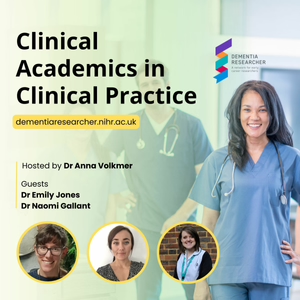
Clinical Academics in Clinical Practice
February 20, 2023
•43m
In this podcast Speech and Language Therapist Dr Anna Volkmer talks with a Nurse and an Occupational Therapist discussing their career pathways from the NHS into academia, and then back to put their training to use on the front-line in the NHS. -- This week’s guests are: Dr Emily Jones, Senior Matron & Lead Dementia Nurse at Portsmouth Hospitals University NHS Trust. Her research focussed on the care of people with dementia in acute hospital settings and how the work system influences nursing staff capacity for high quality relationship centred dementia care. Dr Naomi Gallant, Occupational Therapist Team Lead at King’s College Hospital NHS Foundation Trust. Naomi’s PhD focussed on mealtimes and enabling independence and quality of life for people with dementia. Full biographies on all our guests and a transcript can be found on our website https://www.dementiaresearcher.nihr.ac.uk -- With a number of clinical academic training funding calls open this month (NIHR, Alzheimer’s Society, Alzheimer’s Association, Wellcome Trust etc), we shine a spotlight on the potential for healthcare professionals to take time away and pursue further training, undertaking a MSc, PhD and clinical academic position. Highlighting that the doors this can open to enable you to return to clinical practice or continue as a clinical academic. A clinical academic is a qualified healthcare professional who also works in academia, typically in research, teaching, or both. They balance their time between treating patients, conducting research that contributes to the scientific understanding of their field, and training the next generation of clinicians. Every clinical academic post is different, depending on the specialism, experience, and interests of the individual. Most clinical academics will work for two entities – the NHS and a university – and split their time variably between the two. Many find that their dual role gives them greater career flexibility, and an exciting and varied workload. There is a huge array of clinical academic careers on offer across a diverse range of specialties, making every clinical academic post truly unique. However.... Even if academia isn’t your passion, you can put your academic training to great use in the NHS, as our brilliant host and guests demonstrate. -- Like what you hear? Please review, like, and share our podcast - and don't forget to subscribe to ensure you never miss an episode – and if you prefer to watch rather than listen, you’ll find a video version of this podcast with full captions on our YouTube Channel – http://www.youtube.com/dementiaresearcher -- This podcast is brought to you by University College London / UCLH NIHR Biomedical Research Centre in association with Alzheimer’s Association, Alzheimer's Research UK, Alzheimer's Society and Race Against Dementia who we thank for their ongoing support.
If you like this episode you’ll love



Promoted