


Neuroinflammation drug discovery in stem cell-derived microglia
Dementia Researcher
07/06/20
•40m
About
Comments
Featured In
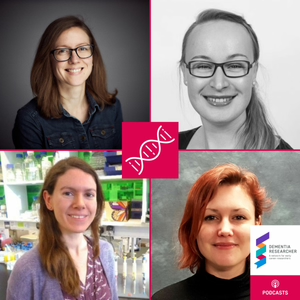
In this week’s podcast we explore why Microglia are awesome, why our panellists use induced pluripotent stem cell models and how they feed Genome wide association studies hits and basic science into drug discovery with phenotypic screening. Meet our panellists: Dr Hazel Hall-Roberts, who is a black belt in Wado-Ryu karate and Postdoctoral Research Scientist at the Sir William Dunn School of Pathology & ARUK Oxford Drug Discovery Institute. Dr Emma Mead a Senior Neurobiologist, allotment holder, kitchen creative and Team Leader at the ARUK Oxford Drug Discovery Institute. Maria Kreger Karabova a DPhil student also at Sir William Dunn School of Pathology, University of Oxford. Maria’s claim to fame is that she once overhead-squatted her postdoc supervisor (I am sure a few of us would like to do that). Megan Calvert-O’Hare is hosting the discussion which was recorded over Zoom (so apologies if the sounds quality isn’t up to our usual high standards). You can find out more about our panellists, and their work on our website www.dementiaresearcher.nihr.ac.uk. A transcript of this podcast is also available here https://www.dementiaresearcher.nihr.ac.uk/podcast-neuroinflammation-drug-discovery-in-stem-cell-derived-microglia _____________________________________________________________________ This podcast is brought to you in association with Alzheimer's Research UK and Alzheimer's Society, who we thank for their ongoing support.
Previous Episode

This week Adam Smith is joined by three early career dementia researchers to discuss mental health struggles and self-care in academia. Are these problems that everyone goes through? Are there strategies that you can employ to help? We had so much to talk about... that we broke it down into two parts and this is part two. Those researchers are: Dr Katie Askew, a Postdoctoral Research Fellow at the University of Edinburgh and owner of two house bunnies called Lola and Floki. Dr Isabel Castanho, a Postdoctoral Researcher at the University of Exeter, and a practitioner of aerial yoga and a front line soldier in the battle against the Omnics (which in layman’s terms means she spends a lot of time playing video games) Last but not least we have Makis Tzioras who is a PhD student also from the University of Edinburgh. Panellists choose the title of each podcast and today is “If you can’t love yourself, then how the hell you gonna love your science?”: A semi-serious chat about self-care in academia” – thanks to Katie for the title. You can find out more about our panellists, and their work on our website www.dementiaresearcher.nihr.ac.uk. A transcript of this podcast is also available here https://www.dementiaresearcher.nihr.ac.uk/??? Like what you hear? Please review, like, and share our podcast - and don't forget to subscribe to ensure you never miss an episode. Enjoy our content? We are pleased to announce that we are now running a Midday Lecture Webinars - find recordings of previous lectures and details on how to register for future events at www.dementiaresearcher.nihr.ac.uk/webinars Please note this podcast was recorded online as a result the sound quality may not be up to our usual high standard. This podcast is brought to you in association with Alzheimer's Research UK and Alzheimer's Society, who we thank for their ongoing support.
Next Episode

ISTAART Relay Podcast - Biofluid Based Biomarkers PIA
July 20, 2020
•27m
A five-part special relay podcast series, where the interviewee becomes the interviewer. With five leading researchers discussing their research, their field, and the work of the Alzheimer’s Association ISTAART Professional Interest Area they represent. Part One - Professor David Scott interviews Professor Henrik Zetterberg David Scott is Director of the Department of Anaesthesia and Acute Pain Medicine, St. Vincent’s Hospital Melbourne and Professor, School of Medicine, University of Melbourne, Australia. David is researches Perioperative Neurocognitive Disorders – in particular, delirium and cognitive decline associated with anaesthesia and surgery. He is representing the Perioperative Cognition and Delirium PIA. Henrik Zetterberg is Professor of Neurochemistry, Senior Consultant in Clinical Chemistry and Head of Department at The Sahlgrenska Academy within the University of Gothenburg, Sweden, and University College London, UK. Henrik’s work is focused on Fluid biomarkers for neurodegenerative dementias. He is representing the Biofluid Based Biomarkers PIA. ______________________________________________ This podcast series is brought to you by Dementia Researcher. You can find out more about our panellists, and their work on our website www.dementiaresearcher.nihr.ac.uk. A transcript of this podcast is also available here https://www.dementiaresearcher.nihr.ac.uk/podcasts ______________________________________________ The Alzheimer's Association International Society to Advance Alzheimer's Research and Treatment (ISTAART) convenes the global Alzheimer's and dementia science community. Members share knowledge, fuel collaboration and advance research to find more effective ways to detect, treat and prevent Alzheimer's and other dementias. Professional Interest Areas (PIA) are an assembly of ISTAART members with common subspecialties or interests. There are currently 25 PIA covering a wide range of interests and fields, from the Alliance of Women Alzheimer's Researchers (AWARE) PIA to Biofluid Based Biomarkers and everything in between. To sign-up to ISTAART and a PIA visit www.alz.org/istaart/ ______________________________________________ Throughout July 2020, Dementia Researcher is giving you a chance to win a pair of Beats Studio Headphones. To be in with a chance to win, complete three east steps: 1. Leave us a review on iTunes 2. Register and attend one of our webinars 3. Register on our website. Winner will be chosen at random on the 1st August, and announced via Twitter follow-us @Dem_Researcher For more information visit www.dementiaresearcher.nihr.ac.uk ______________________________________________ Finally, the views and opinions expressed by guests in this podcast represent those of the guests and do not necessarily reflect those of NIHR Dementia Researchers, PIA membership, ISTAART or the Alzheimer's Association.
If you like this episode you’ll love



Promoted